


Views: 0 Author: Site Editor Publish Time: 2026-04-20 Origin: Site


A wide outdoor site quickly exposes the limits of an ordinary pole layout. When the space is open, traffic is constant, and maintenance access is not simple, a high mast light becomes a practical answer rather than a specialized option. Hengtianyuan Lighting develops outdoor lighting systems for roads, ports, yards, stations, and large public spaces, and this kind of product is especially valuable where broad coverage, stable structure, and long-term service performance matter more than a standard street light arrangement.
A high mast light is not just a taller version of a normal street light. It is a complete lighting system designed for large outdoor areas that need broad and consistent illumination from a higher mounting point. The system usually includes a steel pole, a top-mounted lighting assembly, structural support components, and a maintenance method suited to the height of the installation.
That full-system approach is what makes the product different in real use. A normal street light layout spreads many shorter poles across a site. A high mast setup is intended to reduce visual clutter and light a wider area with fewer installation points. For large infrastructure and industrial projects, that difference changes both the layout strategy and the long-term maintenance plan.
The main job of a high mast light is to deliver wide, uniform illumination across open areas where many smaller poles would be inefficient or difficult to manage. That broad coverage is useful where vehicles, goods, equipment, or people move across large surfaces and require steady visibility after dark.
This is why the product is often chosen for places that remain active late into the evening or throughout the night. Instead of creating isolated bright spots with gaps between them, it aims to create a larger field of usable light. That makes the site easier to navigate, safer to operate, and more orderly in appearance.
The most obvious difference is height, but the real advantage is what that height allows. A high mast light can illuminate a much larger area from one point, which means a project may need fewer poles than a standard street light layout. That can simplify site planning in locations where too many poles would create congestion, reduce movement space, or complicate installation.
For highways, logistics yards, and major open zones, wider coverage is often more valuable than simply increasing the number of fixtures. A well-planned high mast light pole helps create cleaner lighting across a broad site, which can improve visibility and reduce the sense of visual clutter.
Maintenance is another important difference. A standard street light is easier to access because the mounting height is lower, but it also means more poles may need to be serviced across the site. A high mast system is designed with long-term maintenance in mind, and in many cases that includes a lowering mechanism or another practical access method that makes servicing safer and more controlled.
That matters because large-area lighting is not only about installation day. It is also about how the site will be maintained over years of outdoor use. If a project needs fewer poles, it can reduce the number of separate maintenance points across a large area, which is a real operational advantage.
The optics of a high mast light are also designed differently from those of a typical road fixture. The aim is not just to throw light farther, but to distribute it in a way that makes sense for wide outdoor surfaces. Good optical design supports broader uniformity and helps the site function better at night.
This becomes especially important in open work areas, high-speed road environments, and transport zones where visibility should feel stable rather than patchy. For a large site, good light distribution is often what separates usable lighting from lighting that merely appears powerful.
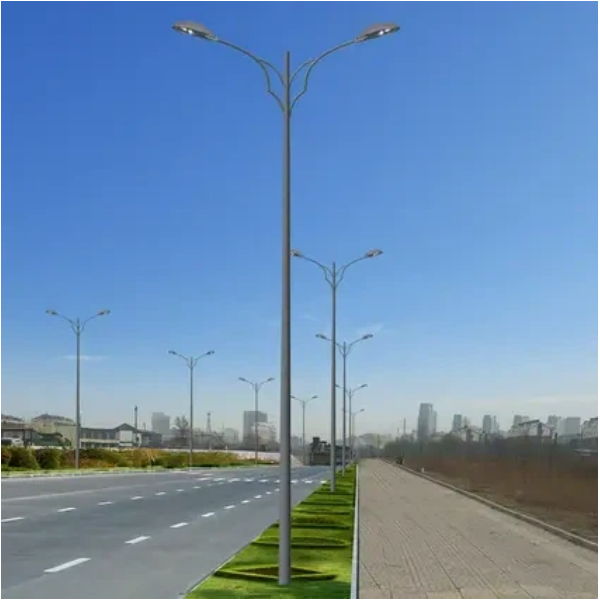
Highways and transport corridors often require lighting across broad road geometry, merging areas, and surrounding open zones. In these locations, a high mast layout can support more consistent visibility while reducing the number of poles needed across the site. That can help keep the layout cleaner and better suited to large-scale road infrastructure.
Ports and logistics yards are demanding environments. They operate for long hours, face heavy vehicle movement, and often deal with large open working surfaces that must remain visible at night. These sites benefit from wide coverage because the activity is spread across loading zones, storage areas, and traffic paths rather than concentrated in one narrow line.
A high mast light suits this environment because it can support a broader lighting field with a stronger sense of order. It also reduces the need to place too many poles in busy working areas where space should remain open for operations.
Not all high mast applications are industrial. Stadium surroundings, event spaces, large parking areas, and public gathering zones also need broad and dependable lighting. These sites often experience fluctuating movement patterns, with heavy activity before and after events. In such spaces, wide-area coverage supports safer movement and a more organized environment.
An industrial street lamp setup has to support work, movement, and safety at the same time. On factory grounds, container yards, equipment zones, or utility bases, too many ordinary poles can interfere with circulation or add unnecessary maintenance points. High mast systems are valuable when the site needs strong coverage with fewer structural interruptions.
Application Area | Main Lighting Challenge | Why High Mast Fits | Design Priority |
Highways | Broad road visibility | Fewer poles across large spaces | Coverage and uniformity |
Ports and logistics yards | Long operating hours and large work zones | Wide-area illumination | Structural durability |
Stadium surroundings | Large crowds and open movement areas | Cleaner lighting layout | Visibility and safety |
Parking areas | Open surfaces with changing activity | Broad light from fewer points | Glare control |
Industrial sites | Space efficiency and maintenance access | Wider coverage with fewer poles | Pole strength and fixture planning |
The common factor across these applications is scale. A high mast solution is most valuable where the site is large enough that a regular street light layout becomes inefficient, crowded, or harder to maintain over time.
The size of the site is one of the first factors that shapes the lighting plan. A larger site often calls for higher mounting positions and a different fixture arrangement, but the decision should still come back to the actual lighting goal. Some projects prioritize broad visibility for movement, while others need stronger illumination in working zones. The height and number of fixtures should follow that goal rather than rely on a fixed formula.
Because these systems stand high and work in open outdoor conditions, structural performance matters a great deal. Wind load, material quality, galvanizing, and fabrication accuracy all affect long-term reliability. A high mast light pole must do more than carry fixtures. It must remain stable and dependable in conditions that may be harsher than the site first appears.
This is where product quality becomes especially important. Large-area lighting is expected to operate for years, often in exposed locations. Weak structural design can lead to maintenance trouble and unnecessary operating risk, which is why high mast projects need serious attention to build quality.
Long-term cost is shaped not only by the pole structure, but also by fixture efficiency and maintenance planning. Efficient LED luminaires can reduce energy consumption while supporting better performance over extended operating hours. Maintenance planning matters because it affects how easily the system can be serviced and how often components may need attention.
For large sites, this is a practical business question as much as a technical one. Lighting should support operations without creating avoidable service burden. That is why many project owners evaluate efficiency, durability, and maintenance access together rather than separately.
High mast lighting is usually selected for sites that cannot afford weak structural quality or unreliable performance. That is why manufacturing and testing deserve close attention. Hengtianyuan Lighting produces outdoor lighting systems and steel poles for demanding public and industrial uses, with a product range that covers road lights, high pole lights, traffic poles, and related outdoor solutions.
For high mast applications, project value comes from more than the visible fixture. It comes from the full combination of pole fabrication, corrosion resistance, structural control, lighting design, and practical delivery support. Large projects need confidence that the system can match the site requirement, remain dependable outdoors, and support long-term use across roads, yards, ports, and other open environments.
A High-mast Lights system is used when an outdoor site needs wider coverage, fewer poles, and a more practical long-term maintenance approach than a regular street light layout can offer. Highways, ports, logistics yards, parking areas, stadium surroundings, and industrial zones are some of the clearest examples. By combining strong structural design with large-area lighting performance, Hengtianyuan Lighting helps project owners build outdoor systems that are better suited to demanding spaces and continuous use. If you are planning a large-site lighting project, contact us to discuss the right solution for your application.
A high mast light is mainly used for large outdoor areas that need wide and uniform illumination, such as highways, ports, logistics yards, parking zones, and industrial sites.
The biggest difference is that a high mast light is designed for much wider coverage from a higher mounting position, which can reduce the number of poles needed across a site.
Because the pole affects structural stability, wind resistance, maintenance access, and the overall safety of the lighting system in exposed outdoor conditions.
It becomes a strong option when the site is large, open, busy, and difficult to manage with many ordinary poles, especially where fewer structures and broader coverage are more practical.


